Founding members · From August 2026

Workforce capability,
built for the people doing the work.

CORA is workforce training and capability reporting for Australian disability and care providers. Built around the support worker on shift, structured to satisfy the auditor at the door.

What CORA is

A senior support worker, in every team.

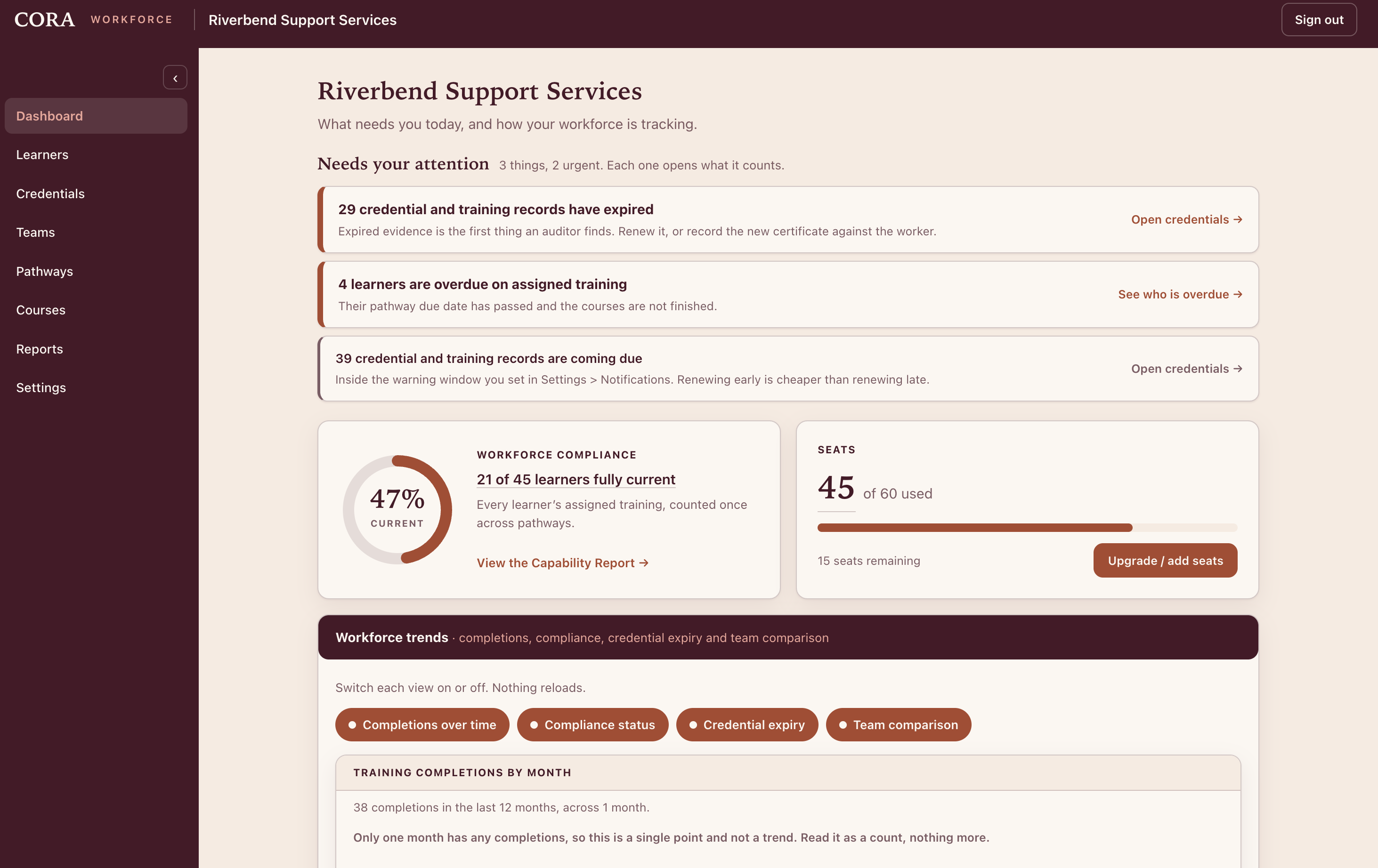
CORA is a workforce capability platform built for Australian disability and care providers. Training, capability tracking, and audit-ready reporting — all in one place, all designed around what a frontline worker actually does on shift.

Most workforce training in this sector is written for auditors. CORA is written for the worker on shift. Every lesson is grounded in something a real worker does, with a real person, in a real support setting. Not theory. Not compliance theatre.

Built in response to a clear sector gap — workforce training that satisfies audit but rarely changes what happens on shift. Grounded in years of frontline practice, the NDIS Practice Standards and Workforce Capability Framework, and the published work of established sector authorities.

Real situations. Real skills. Ready to apply from the very next shift.

The approach

How CORA actually works.

Six things shape every course. They're what make CORA different from compliance training that gets clicked through and forgotten.

Built for the support worker, ready for the auditor.

The voice is closer to a senior support worker mentoring a newer one on shift than a compliance officer reading from a policy. Plain Australian English. Beneath that, every course is mapped to the NDIS Practice Standards, Workforce Capability Framework, and CORA's four capability pillars. The language is for the worker. The structure is for the regulator.

Three lessons, every course, in the same order.

Lesson 1 gives just enough context to ground the topic. Lesson 2 teaches how to apply it on shift, anchored by branching scenarios set in real support settings. Lesson 3 builds consistency — doing it well across different people, different shifts, and unfamiliar situations.

Scenarios that teach, not test.

Every scenario presents a real situation with three response options. Feedback under each option teaches the reasoning — why a response works, what gets missed by a weaker choice, what assumption leads to an incorrect one. No "wrong" option is cartoonishly bad. Every option reflects a choice a real worker might make.

From trained to capable.

Most workforce training proves who completed what. CORA is built to develop workers who can actually do the work — confidently, consistently, and with the kind of judgement that only comes from real experience compressed into structured learning. Course completion isn't the goal. Capability is.

Mobile-first, under 30 minutes.

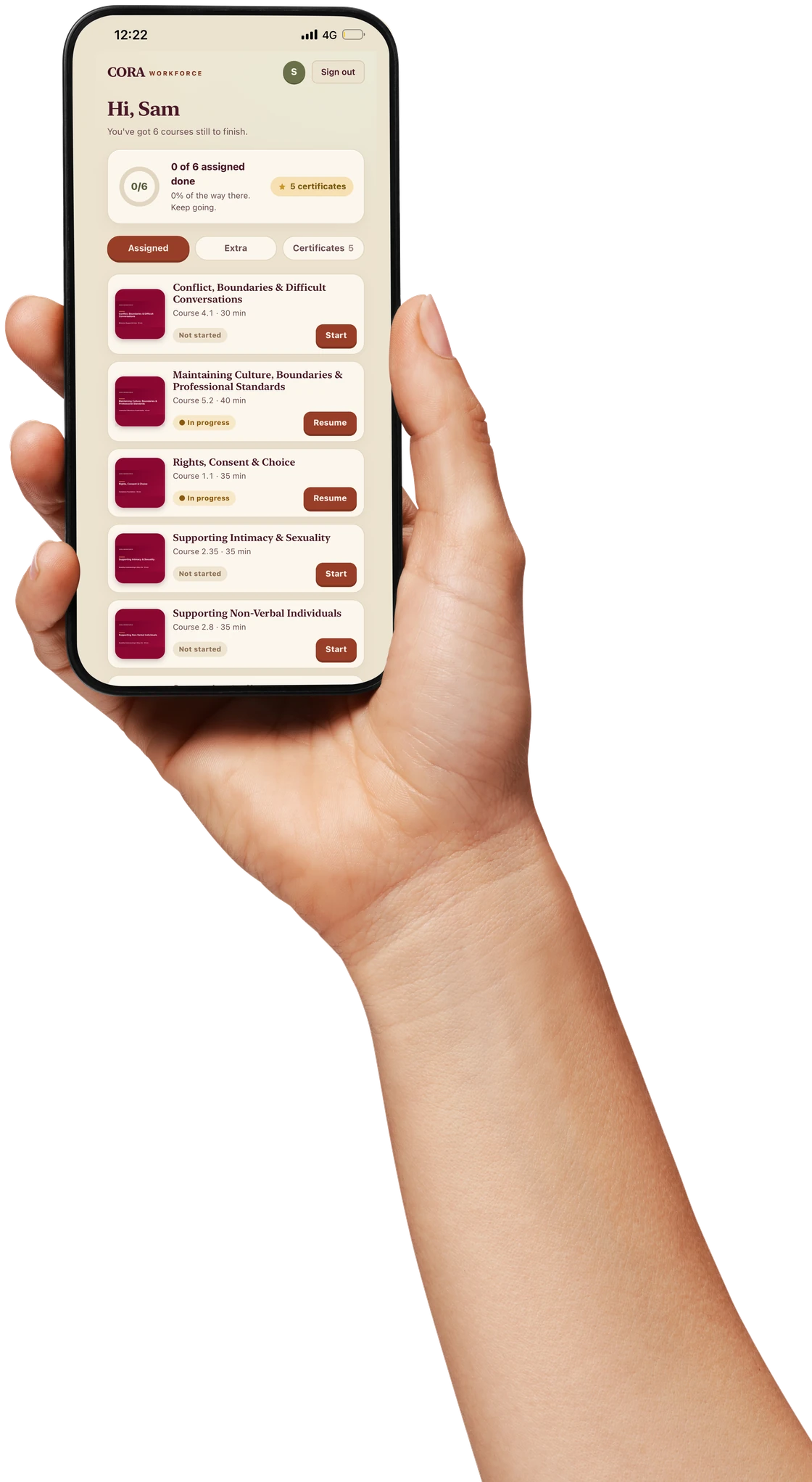
CORA is built around the reality of support work. Every course is designed for a phone, in the kind of 10-20 minute windows workers actually have — between shifts, in transport, on a break. Three short lessons per course, under 30 minutes total. Micro-learning that builds real capability without disrupting the work.

Smart course assignment, not one-size-fits-all.

Not every worker needs every course. CORA's library is structured so providers assign courses by role, team, or the people each worker supports. Compliance Foundations are universal; cohort-specific and leadership content is assigned where it's relevant. The Workforce Readiness Report scores each worker against what they were actually assigned.

The Workforce Readiness Report

Beyond completion: capability you can see.

Course completion tells you who finished what. The Workforce Readiness Report tells you what your workforce is actually capable of, where the risks sit, and what to do about it.

  • Pillar 01 · Lesson 1

    Capability

    The awareness and judgement workers need before they apply skills with confidence.

  • Pillar 02 · Lesson 2

    Operational Consistency

    Every worker applies the same quality of practice, regardless of experience or shift.

  • Pillar 03 · Lesson 3

    Readiness

    Workers are prepared for unfamiliar situations and new challenges as they arise.

  • Pillar 04 · Lesson 3

    Assurance

    Organisations and auditors can see workforce capability clearly and act on it.

See a sample Workforce Readiness Report — exactly what providers receive each quarter.
View sample report →
Where things are at

From now to public launch.

August 2026

Founding members onboard

A small group of provider partners onboarded at reduced rate in exchange for testimonials and feedback. 25+ courses available.

January 2027

Public launch

Full library available. Foundation customers onboarded ahead of public release.

2027 onwards

Continuous review

17 additional courses in the post-launch pipeline. Continuous content review against sector practice and feedback.

Founding members — from August 2026

Want to be part of the first cohort?

CORA is currently recruiting a small group of providers as founding members from August 2026, at reduced rate in exchange for case study participation. If your team is thinking about workforce capability ahead of an audit, we'd love to hear from you.

The CORA Library

56 courses. Six streams. One philosophy.

Every course is built on direct applied learning — three lessons, branching scenarios, and a four-question knowledge check. Mapped to the NDIS Practice Standards, the NDIS Workforce Capability Framework, and CORA's four capability pillars.

Click any course to see the description, the pillars it builds, and the standards it maps to.

56
COURSES AT LAUNCH
6
STREAMS
4
CAPABILITY PILLARS
17
POST-LAUNCH PIPELINE
Stream 01

Compliance Foundations

11 courses

The mandatory regulatory and safety core. Every worker completes these at induction. These are the courses scrutinised hardest at audit, and the ones every NDIS provider must be able to evidence end-to-end.

Participant Rights, Consent & Choice

How workers uphold the rights of the person they support — including the right to make decisions, give and withdraw consent, and exercise choice and control on shift.

CORA pillars
CapabilityOperational Consistency
NDIS Practice Standards
1.1 Person-centred supports1.2 Individual values & beliefs1.3 Privacy & dignity1.4 Independence & informed choice
Workforce Capability Framework
1.1 Uphold my rights1.2 Speak up with me & for me3.2 Support me to make my own decisions
Duty of Care & Dignity of Risk

The everyday balance between keeping people safe and supporting their right to take risks. How workers think through duty of care without becoming overprotective or paternalistic.

CORA pillars
CapabilityReadiness
NDIS Practice Standards
1.4 Independence & informed choice2.2 Risk management4.1 Safe environment
Workforce Capability Framework
1.1 Uphold my rights3.2 Support me to make my own decisions4.1 Provide a safe environment
Restrictive Practices & PBS Fundamentals

What restrictive practices are, why they are a last resort, and the worker's role in reducing and reporting them. Foundational positive behaviour support principles — without teaching application of restrictive techniques.

CORA pillars
CapabilityAssurance
NDIS Practice Standards
2.2 Risk management2.4 Incident management4.4 Implementation of behaviour support plans
Workforce Capability Framework
2.2 Work within your capabilities4.1 Provide a safe environment4.3 Recognise & report violence, abuse, neglect, exploitation
Abuse, Neglect & Incident Reporting

How to recognise the signs of abuse, neglect, and exploitation. The worker's mandatory reporting obligations and how to escalate concerns quickly and correctly.

CORA pillars
CapabilityReadinessAssurance
NDIS Practice Standards
1.5 Violence, abuse, neglect, exploitation & discrimination2.4 Incident management
Workforce Capability Framework
4.3 Recognise & report violence, abuse, neglect, exploitation
Professional Boundaries & Ethics

What professional boundaries look like in disability support — the ethical lines around gifts, personal disclosure, social media, money, and dual relationships.

CORA pillars
CapabilityOperational Consistency
NDIS Practice Standards
1.3 Privacy & dignity2.1 Governance & operational management
Workforce Capability Framework
1.1 Uphold my rights1.4 Be present2.2 Work within your capabilities4.1 Provide a safe environment
Everyday Documentation

Writing case notes, incident records, and shift handovers that meet NDIS requirements. Practical, clear, factual documentation as a daily skill rather than an end-of-shift afterthought.

CORA pillars
Operational ConsistencyAssurance
NDIS Practice Standards
1.4 Independence & informed choice2.1 Governance & operational management3.3 Service agreements
Workforce Capability Framework
2.2 Work within your capabilities3.1 Observe & respond flexibly
Work Health & Safety Induction

WHS fundamentals as they apply to community-based and home-based support work. Hazard identification, safe practice, and the worker's right to a safe workplace.

CORA pillars
CapabilityOperational Consistency
NDIS Practice Standards
2.2 Risk management4.1 Safe environment
Workforce Capability Framework
4.1 Provide a safe environment4.2 Identify & respond to risk
Privacy & Confidentiality

What privacy means in support work — handling personal information, photos, conversations, and digital records with appropriate care. When confidentiality must yield to safety obligations.

CORA pillars
CapabilityOperational Consistency
NDIS Practice Standards
1.3 Privacy & dignity
Workforce Capability Framework
1.1 Uphold my rights1.3 Show your care
Infection Control & Hygiene

Practical infection prevention in everyday support — hand hygiene, PPE, cleaning, and responding to illness. Right-sized for community and home-based contexts, not clinical environments.

CORA pillars
CapabilityOperational Consistency
NDIS Practice Standards
4.1 Safe environment4.5 Medication management
Workforce Capability Framework
4.1 Provide a safe environment4.2 Identify & respond to risk
Emergency, Disaster & Incident Response

What to do when something goes wrong on shift — medical emergencies, evacuations, natural disasters, missing-person situations. The worker's first-response role and when to escalate.

CORA pillars
ReadinessAssurance
NDIS Practice Standards
2.2 Risk management2.4 Incident management4.1 Safe environment
Workforce Capability Framework
4.1 Provide a safe environment4.2 Identify & respond to risk4.3 Recognise & report violence, abuse, neglect, exploitation
Feedback, Complaints & Speaking Up

How workers respond when the person they support or their family raises concerns. Worker rights and obligations around making complaints themselves — and supporting others to do so.

CORA pillars
CapabilityAssurance
NDIS Practice Standards
1.5 Violence, abuse, neglect, exploitation & discrimination3.5 Responsive support provision6.1 Feedback & complaints management
Workforce Capability Framework
1.2 Speak up with me & for me4.3 Recognise & report violence, abuse, neglect, exploitation
Stream 02

Disability Understanding & Daily Life

18 courses

Knowing the people you support, and the practical methods that anchor good daily-life support across different cohorts and settings. Every course in this stream reinforces that workers follow the person's lead, not their label.

Understanding: Autism

Practical understanding of autism for support workers, written with input from autistic-led perspectives. Identity-first language with explicit acknowledgement that workers follow the person's lead.

CORA pillars
CapabilityOperational Consistency
NDIS Practice Standards
1.1 Person-centred supports1.2 Individual values & beliefs3.1 Access to supports
Workforce Capability Framework
1.1 Uphold my rights3.1 Observe & respond flexibly3.3 Build my capacity to participate
Understanding: Acquired Brain Injury (ABI)

What ABI means for the person, how it can present day-to-day, and how to support someone whose cognitive, emotional, or physical capacity may have changed.

CORA pillars
CapabilityOperational Consistency
NDIS Practice Standards
1.1 Person-centred supports3.1 Access to supports3.4 Responsive support provision
Workforce Capability Framework
3.1 Observe & respond flexibly3.3 Build my capacity to participate
Neurodiversity-Affirming Support

What it means to work in a neurodiversity-affirming way — moving beyond deficit-based frames toward strengths-based, identity-respecting practice across all neurotypes.

CORA pillars
CapabilityOperational Consistency
NDIS Practice Standards
1.1 Person-centred supports1.2 Individual values & beliefs
Workforce Capability Framework
1.1 Uphold my rights1.3 Show your care3.1 Observe & respond flexibly
Understanding: Intellectual Disability

Practical understanding of intellectual disability, communication adaptations, and how to support participation, learning, and decision-making in ways that build capacity over time.

CORA pillars
CapabilityOperational Consistency
NDIS Practice Standards
1.1 Person-centred supports1.4 Independence & informed choice3.4 Responsive support provision
Workforce Capability Framework
3.1 Observe & respond flexibly3.2 Support me to make my own decisions3.3 Build my capacity to participate
Understanding: Pathological Demand Avoidance (PDA)

What PDA is and isn't, how it can present on shift, and practical strategies for supporting someone whose nervous system experiences everyday demands as threats. Written for workers — not clinical practitioners.

CORA pillars
CapabilityReadiness
NDIS Practice Standards
1.1 Person-centred supports3.4 Responsive support provision
Workforce Capability Framework
3.1 Observe & respond flexibly3.3 Build my capacity to participate
Understanding: Functional Neurological Disorder (FND)

Plain-language understanding of FND, common presentations, and how to support someone in ways that respect both the reality of their symptoms and current evidence-informed approaches.

CORA pillars
CapabilityOperational Consistency
NDIS Practice Standards
1.1 Person-centred supports3.4 Responsive support provision
Workforce Capability Framework
1.3 Show your care3.1 Observe & respond flexibly
Understanding: ADHD

Practical understanding of ADHD in adults and how it shapes daily life. Strategies for supporting executive function, planning, and self-regulation without being prescriptive.

CORA pillars
CapabilityOperational Consistency
NDIS Practice Standards
1.1 Person-centred supports3.4 Responsive support provision
Workforce Capability Framework
3.1 Observe & respond flexibly3.3 Build my capacity to participate
Supporting Non-Verbal Individuals

Communication-first support for people who use AAC, signing, gesture, behaviour, or other non-verbal means. Following the person's lead, learning their communication system, never speaking over them.

CORA pillars
CapabilityOperational ConsistencyReadiness
NDIS Practice Standards
1.1 Person-centred supports1.4 Independence & informed choice3.4 Responsive support provision
Workforce Capability Framework
1.1 Uphold my rights1.2 Speak up with me & for me3.1 Observe & respond flexibly
Person-Centred Active Support (PCAS)

The PCAS methodology in practice — every moment is a potential opportunity for engagement and participation. Practical skills for supporting people to take part in their own lives, not just have things done for them.

CORA pillars
CapabilityOperational ConsistencyReadiness
NDIS Practice Standards
1.1 Person-centred supports1.4 Independence & informed choice3.4 Responsive support provision
Workforce Capability Framework
3.1 Observe & respond flexibly3.3 Build my capacity to participate
Balancing Support — Doing With vs Doing For

The everyday judgement of when to step in, when to step back, and how to do support that builds capacity rather than dependence. Direct extension of PCAS principles into specific shift moments.

CORA pillars
CapabilityOperational Consistency
NDIS Practice Standards
1.4 Independence & informed choice3.4 Responsive support provision
Workforce Capability Framework
3.3 Build my capacity to participate
Attending Appointments: Preparation, Support & Follow-Up

Supporting someone before, during, and after appointments — medical, allied health, NDIS planning, or otherwise. Preparation, advocacy on the day, and follow-through with the person and their team.

CORA pillars
Operational ConsistencyReadiness
NDIS Practice Standards
1.1 Person-centred supports3.4 Responsive support provision4.5 Medication management
Workforce Capability Framework
1.2 Speak up with me & for me3.1 Observe & respond flexibly
Supporting Mealtimes

Practical support around food, eating, and mealtimes — including dysphagia awareness, choking risk recognition, mealtime management plans, and the social side of meals as connection.

CORA pillars
Operational ConsistencyReadiness
NDIS Practice Standards
3.4 Responsive support provision4.1 Safe environment4.5 Mealtime management
Workforce Capability Framework
3.1 Observe & respond flexibly4.1 Provide a safe environment4.2 Identify & respond to risk
Recognising Changes in Health & When to Escalate

How to notice when something is changing for the person you support — small signs, gradual shifts, new presentations. The worker's role in escalating concerns to the right people at the right time.

CORA pillars
ReadinessAssurance
NDIS Practice Standards
2.4 Incident management3.4 Responsive support provision4.1 Safe environment
Workforce Capability Framework
3.1 Observe & respond flexibly4.2 Identify & respond to risk
Medication Awareness for Support Workers

What support workers can and can't do around medication, recognising medication-related changes, recording and reporting requirements. Not medication administration training — awareness training.

CORA pillars
CapabilityOperational ConsistencyAssurance
NDIS Practice Standards
3.4 Responsive support provision4.5 Medication management
Workforce Capability Framework
2.2 Work within your capabilities4.1 Provide a safe environment4.2 Identify & respond to risk
Supported Decision-Making

How to support someone to make their own decisions — including big ones — using will, preferences and rights as the anchor. Distinguishing supported decision-making from substituted decision-making.

CORA pillars
CapabilityOperational Consistency
NDIS Practice Standards
1.1 Person-centred supports1.4 Independence & informed choice
Workforce Capability Framework
1.1 Uphold my rights1.2 Speak up with me & for me3.2 Support me to make my own decisions
Supporting People with Psychosocial Disability

What psychosocial disability is, how it intersects with mental health conditions, and what good NDIS support looks like — recovery-oriented, capacity-building, individually directed.

CORA pillars
CapabilityOperational Consistency
NDIS Practice Standards
1.1 Person-centred supports3.4 Responsive support provision
Workforce Capability Framework
1.3 Show your care3.1 Observe & respond flexibly3.3 Build my capacity to participate
Cultural Awareness & Inclusive Practice

Practical cultural responsiveness on shift — recognising your own assumptions, working across cultural difference, and providing support that respects the person's culture, faith, identity, and community.

CORA pillars
CapabilityOperational Consistency
NDIS Practice Standards
1.1 Person-centred supports1.2 Individual values & beliefs
Workforce Capability Framework
1.1 Uphold my rights1.3 Show your care3.1 Observe & respond flexibly
Culturally Safe Practice — First Nations Contexts

Foundational cultural safety for working with First Nations people. The role of colonial history in current disability experiences, kinship structures, communication, and connection to Country.

CORA pillars
CapabilityOperational Consistency
NDIS Practice Standards
1.1 Person-centred supports1.2 Individual values & beliefs
Workforce Capability Framework
1.1 Uphold my rights1.3 Show your care3.1 Observe & respond flexibly
Stream 03

Mental Health & Wellbeing

5 courses

Recognising and responding to emotional and psychological needs. Focused on building worker capacity to follow the person's lead, support consistently, and practise in an informed way.

Supporting People with Anxiety

How anxiety presents day-to-day, practical strategies for supporting someone through anxious moments, and the worker's role — including knowing when to step back and let strategies the person already uses take over.

CORA pillars
CapabilityOperational Consistency
NDIS Practice Standards
1.1 Person-centred supports3.4 Responsive support provision
Workforce Capability Framework
1.3 Show your care3.1 Observe & respond flexibly3.3 Build my capacity to participate
Supporting People with Depression

Recognising depression in the people you support, providing consistent and informed support, and avoiding the common mistakes that make things harder. The worker's role in noticing, supporting, and escalating.

CORA pillars
CapabilityOperational Consistency
NDIS Practice Standards
1.1 Person-centred supports3.4 Responsive support provision
Workforce Capability Framework
1.3 Show your care3.1 Observe & respond flexibly
Trauma-Informed Practice for Support Workers

What it means to work in a trauma-informed way — recognising that trauma shapes how people experience support, and how to build safety, choice, and trust into everyday practice.

CORA pillars
CapabilityOperational ConsistencyReadiness
NDIS Practice Standards
1.1 Person-centred supports1.3 Privacy & dignity3.4 Responsive support provision
Workforce Capability Framework
1.3 Show your care1.4 Be present3.1 Observe & respond flexibly
Suicide Awareness for Support Workers

How to notice warning signs, have a direct conversation about suicide, and escalate quickly and safely. Aligned with Mindframe and LifeInMind safe messaging guidelines. Not a counselling course — an awareness course.

CORA pillars
ReadinessAssurance
NDIS Practice Standards
1.5 Violence, abuse, neglect, exploitation & discrimination2.4 Incident management3.4 Responsive support provision
Workforce Capability Framework
1.3 Show your care4.2 Identify & respond to risk4.3 Recognise & report violence, abuse, neglect, exploitation
LGBTQIA+ Inclusive Practice

Foundational inclusive practice for working with LGBTQIA+ people you support. Using correct pronouns and language, recognising the impact of past discrimination, and building inclusion into everyday practice.

CORA pillars
CapabilityOperational Consistency
NDIS Practice Standards
1.1 Person-centred supports1.2 Individual values & beliefs1.3 Privacy & dignity
Workforce Capability Framework
1.1 Uphold my rights1.3 Show your care3.1 Observe & respond flexibly
Stream 04

Behaviour Support & Crisis

7 courses

Skills for the more complex, sensitive, and volatile moments of support work — when behaviour escalates, conversations get hard, or the relationship demands particular care. Function-of-behaviour framing throughout.

Conflict, Boundaries & Difficult Conversations

How workers hold steady in moments of conflict — with the person they support, with families, or in team contexts. Maintaining warmth and boundaries simultaneously, without becoming defensive or punitive.

CORA pillars
CapabilityReadiness
NDIS Practice Standards
1.5 Violence, abuse, neglect, exploitation & discrimination6.1 Feedback & complaints management
Workforce Capability Framework
1.3 Show your care1.4 Be present4.1 Provide a safe environment
Understanding Behaviour of Concern

What behaviour of concern is, why it happens, and what it's communicating. Function-of-behaviour framing — every behaviour serves a purpose, and the worker's job is to understand it, not control it.

CORA pillars
CapabilityOperational Consistency
NDIS Practice Standards
4.4 Implementation of behaviour support plans
Workforce Capability Framework
3.1 Observe & respond flexibly4.1 Provide a safe environment
Understanding Triggers & Antecedents

Identifying what's happening before behaviour escalates — environmental, emotional, sensory, relational. Practical skill for noticing patterns, anticipating triggers, and supporting regulation early.

CORA pillars
CapabilityOperational ConsistencyReadiness
NDIS Practice Standards
4.4 Implementation of behaviour support plans
Workforce Capability Framework
3.1 Observe & respond flexibly4.2 Identify & respond to risk
Responding to Crisis, Escalation & Distress

What to do when someone is escalating — de-escalation principles, presence and tone, knowing when to step back, when to seek help, when to call emergency services. Worker safety and the person's dignity throughout.

CORA pillars
ReadinessAssurance
NDIS Practice Standards
2.4 Incident management4.4 Implementation of behaviour support plans
Workforce Capability Framework
3.1 Observe & respond flexibly4.1 Provide a safe environment4.2 Identify & respond to risk
Splitting Behaviours — Practical Support Strategies

Recognising when splitting is happening between workers, families, or team members — and responding in ways that hold consistency and protect the relationship without becoming punitive or rigid.

CORA pillars
CapabilityOperational Consistency
NDIS Practice Standards
4.4 Implementation of behaviour support plans
Workforce Capability Framework
1.4 Be present3.1 Observe & respond flexibly
Supporting Intimacy & Sexuality

How workers support the right to relationships, intimacy, and sexuality — including for people with intellectual disability, complex needs, or limited communication. Practical, rights-based, and non-judgemental.

CORA pillars
CapabilityOperational Consistency
NDIS Practice Standards
1.1 Person-centred supports1.2 Individual values & beliefs1.4 Independence & informed choice
Workforce Capability Framework
1.1 Uphold my rights1.3 Show your care3.2 Support me to make my own decisions
Working with Families, Carers & Guardians

How workers navigate the relationship with families and carers — collaborating well, managing differences in views, and centring the person you support without alienating the people around them.

CORA pillars
CapabilityOperational Consistency
NDIS Practice Standards
1.1 Person-centred supports3.4 Responsive support provision
Workforce Capability Framework
1.3 Show your care1.4 Be present3.1 Observe & respond flexibly
Stream 05

Leadership & Workforce Sustainability

8 courses

Frontline leadership skills for team leaders and supervisors. Not HR processes — the practical craft of supporting a team that supports people. Designed for the people who hold teams together day-to-day.

Supervising Support Workers: Coaching, Feedback & Accountability

Practical supervision skills — coaching conversations, useful feedback, accountability without micromanagement. Building the supervisory capability that frontline managers usually pick up on the job.

CORA pillars
CapabilityOperational Consistency
NDIS Practice Standards
2.1 Governance & operational management2.3 Quality management
Workforce Capability Framework
2.2 Work within your capabilities5.1 Develop self-managing teams (Leaders)
Maintaining Culture, Boundaries & Professional Standards

How frontline leaders set and hold the standards of practice in their teams — including the small everyday decisions that shape what becomes normal. Recognising and addressing professional drift early.

CORA pillars
CapabilityOperational Consistency
NDIS Practice Standards
2.1 Governance & operational management2.3 Quality management
Workforce Capability Framework
1.4 Be present2.2 Work within your capabilities5.2 Coach for growth (Leaders)
Supporting Staff Wellbeing, Burnout & Emotional Load

How leaders notice and respond to worker distress, burnout, and vicarious trauma — building team practices that protect mental health and recognising when escalation or intervention is needed.

CORA pillars
ReadinessAssurance
NDIS Practice Standards
2.1 Governance & operational management
Workforce Capability Framework
1.3 Show your care5.1 Develop self-managing teams (Leaders)
Coordinating Team Meetings

How to run team meetings that actually move the work forward — practical agenda design, facilitation, decision-making, and follow-through. The unglamorous middle skill of frontline leadership.

CORA pillars
Operational Consistency
NDIS Practice Standards
2.1 Governance & operational management
Workforce Capability Framework
5.1 Develop self-managing teams (Leaders)
Supporting Continuity & Consistency of Supports

How frontline leaders maintain consistency across workers, shifts, and locations — handovers, documentation, role clarity, communication. The infrastructure that makes good support reliable rather than accidental.

CORA pillars
Operational ConsistencyAssurance
NDIS Practice Standards
2.1 Governance & operational management3.4 Responsive support provision
Workforce Capability Framework
3.1 Observe & respond flexibly5.1 Develop self-managing teams (Leaders)
Understanding Your Role in the Workforce

What it means to be a frontline leader rather than a senior support worker — the identity shift, the new tensions, and how to think about the role itself. Often the missing piece in promotions.

CORA pillars
Capability
NDIS Practice Standards
2.1 Governance & operational management
Workforce Capability Framework
2.2 Work within your capabilities5.1 Develop self-managing teams (Leaders)
Managing Difficult Conversations (Leaders)

Specifically for frontline leaders — the conversations that supervisors avoid the longest. Practice concerns, value conflicts, escalating issues. How to start them, how to land them, how to follow through.

CORA pillars
Readiness
NDIS Practice Standards
2.1 Governance & operational management2.3 Quality management
Workforce Capability Framework
1.4 Be present5.2 Coach for growth (Leaders)
Addressing Performance & Building Accountability

What performance management actually means at the frontline level — not formal processes, but everyday accountability done well. When to coach, when to address directly, when to escalate.

CORA pillars
CapabilityOperational Consistency
NDIS Practice Standards
2.1 Governance & operational management2.3 Quality management
Workforce Capability Framework
2.2 Work within your capabilities5.2 Coach for growth (Leaders)
Stream 06

Soft Skills

7 courses

The interpersonal and self-management skills that turn a trained worker into a capable one. The skills that don't appear in policy but show up in every shift — the relational craft of support work.

Building Trust & Rapport from Day One

How workers build genuine rapport with the people they support — without performing warmth or oversharing. Practical relational craft: presence, curiosity, follow-through, consistency.

CORA pillars
CapabilityOperational Consistency
NDIS Practice Standards
1.1 Person-centred supports1.3 Privacy & dignity
Workforce Capability Framework
1.3 Show your care1.4 Be present3.1 Observe & respond flexibly
Working in a Person's Home — Rights, Presence & Practice

What it means to enter, occupy, and work in someone's home. The everyday practice of respecting their space, possessions, routines, and rhythms — and noticing when you're getting it wrong.

CORA pillars
CapabilityOperational Consistency
NDIS Practice Standards
1.1 Person-centred supports1.3 Privacy & dignity4.1 Safe environment
Workforce Capability Framework
1.1 Uphold my rights1.4 Be present4.1 Provide a safe environment
Active Listening in Support Work

Listening as a working skill — not a personality trait. How to listen for what someone means, not just what they say. How to make space for slow communication. How to know when listening matters most.

CORA pillars
CapabilityOperational Consistency
NDIS Practice Standards
1.1 Person-centred supports
Workforce Capability Framework
1.3 Show your care1.4 Be present3.1 Observe & respond flexibly
Emotional Regulation for Support Workers

The internal skill of staying regulated when shifts get hard — recognising your own activation, knowing what calms you down, and not bringing personal dysregulation into the support relationship.

CORA pillars
CapabilityReadiness
NDIS Practice Standards
1.3 Privacy & dignity
Workforce Capability Framework
1.4 Be present2.2 Work within your capabilities
Giving & Receiving Feedback (Frontline Workers)

How to give and receive feedback as a frontline worker — with peers, supervisors, the person you support, and their family. Building the capacity for honest, ongoing two-way communication.

CORA pillars
CapabilityOperational Consistency
NDIS Practice Standards
6.1 Feedback & complaints management
Workforce Capability Framework
1.4 Be present2.2 Work within your capabilities
Navigating Power Dynamics in Support Relationships

The honest reality of power in support work — that the worker has significant influence over the person's daily life. How to notice power, hold it carefully, and consistently work to share it back.

CORA pillars
CapabilityOperational Consistency
NDIS Practice Standards
1.1 Person-centred supports1.3 Privacy & dignity1.4 Independence & informed choice
Workforce Capability Framework
1.1 Uphold my rights1.2 Speak up with me & for me3.2 Support me to make my own decisions
Self-Care & Sustaining Your Practice

Real self-care for support workers — not bubble baths and platitudes. The daily, weekly, and structural practices that sustain people in this work over years rather than burning them out in months.

CORA pillars
CapabilityReadiness
NDIS Practice Standards
2.1 Governance & operational management
Workforce Capability Framework
2.2 Work within your capabilities

Want to see CORA in action?

See a sample Workforce Readiness Report — the quarterly executive view providers receive on the Plus tier.

View sample report
Plans & pricing

Honest pricing, built for providers.

CORA is sold by 30-seat block per year. One tier across the whole organisation, so pricing stays simple. All prices in AUD, ex-GST.

Founding member rates

Available from August 2026 — reduced pricing for founding members in exchange for case study participation and feedback. Limited spots for the first cohort.

Enquire about founding membership

Mini Pack

Entry tier for organisations with up to 15 workers
$1,200
per year, 15 seats
$80 per seat per year
  • Full access to all 56 CORA courses
  • Each course mapped to NDIS Practice Standards and Workforce Capability Framework
  • Completion certificates
  • Mobile-first learning, full admin reporting
  • Australian-hours customer support
  • Standalone tier — for organisations of up to 15 workers. Not combinable with Essential or Plus.
Get started with Mini

Essential

Full workforce training for any size organisation
$1,950
per 30-seat block per year
$65 per seat per year
  • Full access to all 56 CORA courses
  • Each course mapped to NDIS Practice Standards and Workforce Capability Framework
  • Completion certificates
  • Mobile-first learning, full admin reporting
  • Stackable 30-seat blocks (60, 90, 120+ seats)
  • Custom branding available (one-time add-on)
  • Australian-hours customer support
Get started with Essential
01

Buy by the 30-seat block

Essential and Plus are sold per 30-seat block per year. A 70-worker organisation buys 3 blocks (90 seats). One tier applies across the whole organisation — no tier-mixing within a provider.

02

Upgrade mid-year if you need to

Started on Essential and want the Workforce Readiness Report before audit? Upgrade to Plus mid-year and only pay the difference. Prorated, no penalty.

03

Volume discounts built in

Per-seat rates already reduce at scale. Above 90 seats you get better effective pricing; above 150 seats we'll quote directly. No hidden discount tiers, no "contact for pricing" games.

Add-ons

A couple of optional extras.

Most providers won't need these. Listed for transparency.

Custom branding (Essential only)

$950 one-time

Your organisation's logo and colour on the Talent LMS interface and completion certificates. One-time setup fee — not an ongoing customisation service. Included on Plus tier at no extra cost.

Implementation support

Included

Setup, course assignment, and worker enrolment is included on every tier. No implementation fee, no separate onboarding charge. We help you get running and check in at 30, 60, and 90 days.

Common questions

The questions providers ask.

Can I combine Mini Pack with Essential or Plus?

No. Mini Pack is a standalone tier — designed for organisations of up to 15 workers. It's not combinable with Essential or Plus, and it's available once per provider.

If you have more than 15 workers, Essential is the starting point. Essential and Plus scale by the 30-seat block: a 60-worker organisation buys 2 blocks, a 90-worker organisation buys 3 blocks, and so on.

Can different teams in our organisation be on different tiers?

No. One tier applies across the whole organisation. If you're on Essential, every block is Essential. If you're on Plus, every block is Plus.

This keeps pricing simple and ensures the Workforce Readiness Report covers your entire workforce rather than just part of it.

What's the difference between Essential and Plus, really?

Same library, same courses, same training experience for workers. The difference is what you get back as an organisation.

Essential shows you who completed what — standard completion data from Talent LMS. Useful for tracking training delivery.

Plus adds the Workforce Readiness Report — a quarterly executive view that scores your workforce against the four CORA capability pillars, shows audit-readiness across NDIS Practice Standards, flags individual workers needing follow-up, and recommends actions for the next quarter. Built for quality leads, board reporting, and audit preparation.

Can we upgrade mid-year?

Yes. Tier upgrades are prorated. A common path is starting on Essential and upgrading to Plus before your audit cycle — you pay only the difference for the remainder of the period.

What about volume discounts for larger organisations?

Volume scaling is built into the per-seat price. Above 90 seats, the effective per-seat rate reduces. Above 150 seats, we'll quote directly based on your specific workforce setup — get in touch and we'll work it out together.

How are payments handled?

Annual billing in advance, via Stripe (credit card) or invoice (EFT). All prices ex-GST; GST added at checkout for Australian organisations. Tax invoices issued for every payment.

What happens if it doesn't work for our team?

Annual subscriptions don't auto-renew without your confirmation. If CORA isn't working for your workforce, we'd rather know before renewal so we can either fix it or part ways cleanly. We check in at 30, 60, and 90 days after onboarding to catch issues early.

Is the platform NDIS-aligned end-to-end?

Yes. Every CORA course is built against the NDIS Practice Standards and the NDIS Workforce Capability Framework, with explicit mapping visible on completion certificates. Plus-tier reports show audit-readiness across all mapped Practice Standards.

That said, CORA covers what eLearning can cover well — knowledge, judgement, applied decision-making. It doesn't replace supervised practicum for high-intensity clinical tasks (PEG feeding, tracheostomy care, etc.), which require hands-on training.

Ready to talk it through?

If you'd like to see the platform, talk through fit for your workforce, or discuss becoming a soft-launch partner, get in touch.

hello@coraworkforce.com.au
ILLUSTRATIVE SAMPLE — All data, provider names, worker names, and recommendations shown below are fictional, used for demonstration only.
Sample Workforce Readiness Report

What providers receive every quarter.

A worked example of the CORA Workforce Readiness Report — the quarterly executive document Plus-tier subscribers receive. Built around the four CORA capability pillars, structured for internal quality review, board reporting, and audit preparation.

SAMPLE
CORA.
Example Care Co.
Reporting period · Q2 2027 (Apr–Jun)
Report issued · 8 July 2027
Workforce Readiness Report

Quarterly capability review

Workforce capability across Example Care Co., scored against the four CORA pillars.

A workforce trending in the right direction, with two clear areas to address before Q3.

Across Q2 2027, Example Care Co. recorded measurable improvement across three of the four CORA capability pillars. Overall workforce capability sits at 78%, up four points on the previous quarter, driven primarily by strong completion rates in Stream 1 (Compliance Foundations) and steady progress through Stream 6 (Soft Skills) following the May team-leader push.

Operational Consistency remains the strongest pillar at 84%, supported by completion of branching-scenario assessments across the SIL team. Readiness is the lowest-scoring pillar at 67%, with three of the four cohort-specific courses (Autism, ABI, PDA) showing engagement levels below 60% among newer workers. This is the most urgent area to address ahead of the September audit cycle.

Two individual workers have been flagged for supervisor follow-up — one for incomplete compliance training, one for an emerging engagement pattern across the last six weeks. Twelve NDIS Practice Standards are well-supported by current workforce data; two are flagged as at-risk if an audit landed today.

Audit readiness

Currently audit-ready across 14 of 16 mapped Practice Standards. Two flagged for action before September audit cycle.

On track

The four CORA capability pillars.

Each pillar reflects a different facet of workforce capability. All scores are out of 100. Quarter-on-quarter change shown below each.

Capability
79
+5 vs Q1

The awareness and judgement workers bring before they apply skills. Built primarily in Lesson 1 of every course.

Operational Consistency
84
+3 vs Q1

Every worker applying the same quality of practice regardless of experience. Strongest pillar this quarter.

Readiness
67
−2 vs Q1

Worker preparation for unfamiliar situations. Lowest pillar this quarter — priority area for Q3.

Assurance
82
+6 vs Q1

Audit-readiness and visibility for leadership. Improved by completion-tracking uplift across SIL team in May.

Where capability is strong, where it's patchy.

Pillar scores broken down by team. Scores below 70 are flagged amber; below 60 red.

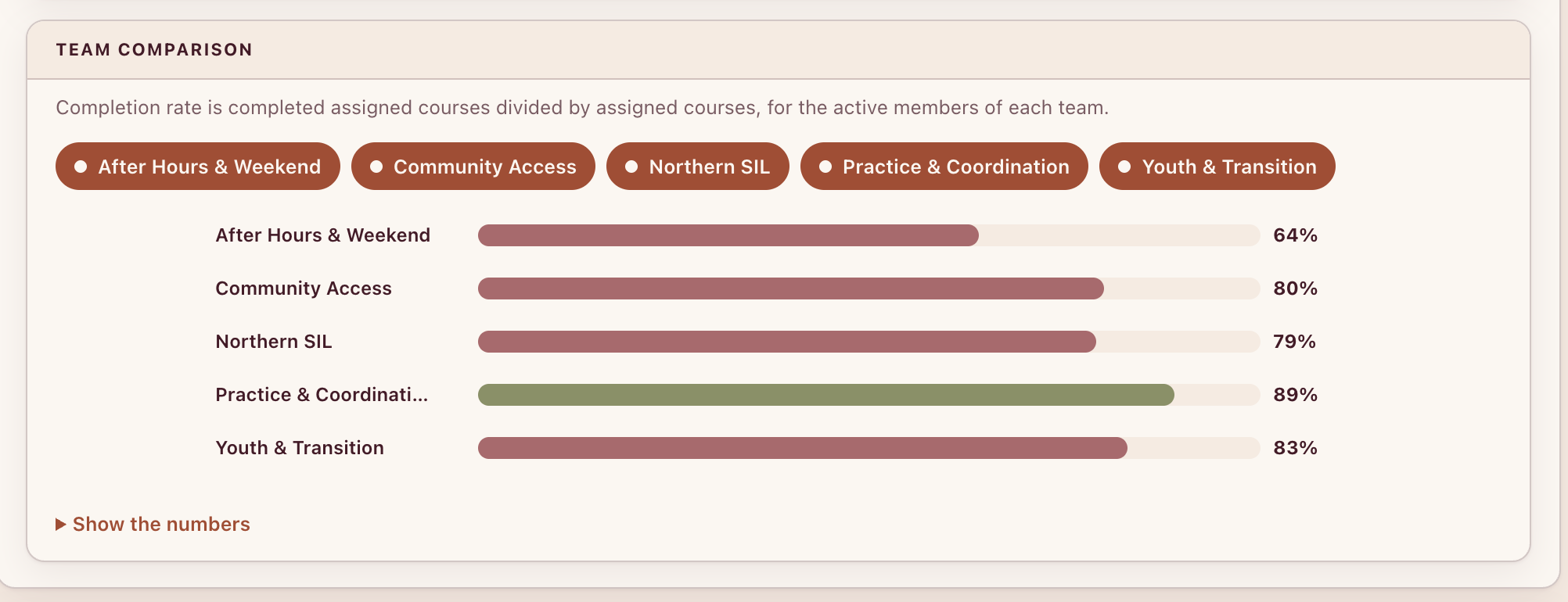
Team / Location Capability Op. Consistency Readiness Assurance Workers
SIL — Western suburbs 86 91 78 88 18
SIL — Northern suburbs 82 85 71 84 14
Community access 77 81 68 79 22
Daily living supports 72 78 58 76 9
New starters (< 90 days) 68 74 52 75 6

Workers identified for supervisor follow-up.

Workers flagged on completion gaps or engagement patterns. Names anonymised below to protect privacy in this sample.

Worker A — Daily living supports
Incomplete: Abuse, Neglect & Incident Reporting · Restrictive Practices & PBS Fundamentals (overdue 6 weeks)
High priority
Worker B — Community access
Engagement pattern: 4 of last 6 scheduled course sessions skipped. No completed assessments since 12 May.
Engagement
3 new starters — Cohort June 2027
On track but readiness training (Lesson 3) yet to begin. Recommend scheduling ahead of full-shift roster.
Watch

Where audit evidence is strong — and where it isn't.

Each Practice Standard, mapped to workforce completion data. Percentages reflect what proportion of the workforce has completed the courses underpinning each standard.

1.1
Person-centred supports
94%
1.3
Privacy & dignity
91%
1.4
Independence & informed choice
88%
1.5
Abuse, neglect, exploitation
86%
2.1
Governance & operations
82%
2.2
Risk management
73%
2.4
Incident management
81%
3.4
Responsive support provision
79%
4.1
Safe environment
87%
4.4
Behaviour support plans
58%
4.5
Medication management
84%
6.1
Feedback & complaints
90%

Three priorities for the next quarter.

Recommendation 01 · High priority

Close behaviour support plan implementation gap before September audit.

Practice Standard 4.4 sits at 58% — the lowest-mapped standard this quarter, and likely to be tested in audit. Schedule the full SIL and daily living teams through "Understanding Behaviour of Concern" and "Responding to Crisis, Escalation & Distress" before 31 August.

Stream 4: Behaviour Support & Crisis NDIS Standard 4.4
Recommendation 02 · Priority

Address new starter readiness gap with structured onboarding pathway.

New starters (under 90 days) score 52 on Readiness — significantly below other teams. Recommend formalising a CORA onboarding pathway covering Lesson 3 readiness content across Streams 1, 2, and 4 within 60 days of commencement.

Pillar: Readiness Onboarding · 6 workers
Recommendation 03 · Standard

Follow up directly with the two flagged individual workers.

Worker A's overdue compliance training is the highest individual risk. Worker B's engagement drop-off is the kind of pattern that often predicts churn at 9–12 months. Both warrant a direct supervisor conversation in the next two weeks.

Individual follow-up Supervisor action
Workforce Readiness Report · Example Care Co. · Q2 2027 · Generated by CORA Workforce · For internal quality, board reporting, and audit preparation

About this sample

Everything in this report is fictional and shown for illustration only. "Example Care Co.", all team and worker references, scores, percentages, and recommendations have been generated as a worked example of the report format. Real CORA Workforce Readiness Reports are produced quarterly for Plus-tier providers using actual workforce data from the CORA platform, and reflect the unique shape of each organisation's workforce and operations.

Want to see a real report for your workforce?

CORA is currently recruiting founding member providers from August 2026. Reach out to talk through fit and pricing.

hello@coraworkforce.com.au
Questions & answers

The questions providers ask.

Substantive answers to the questions quality leads, training managers, and CEOs ask before bringing CORA to their organisation. If something isn't covered, just ask.

01

Getting started

How long does it take to set up?

Setup is fast — most providers are running within a few days. Once you sign up, we configure your CORA admin dashboard, enrol your workers, and set up your initial course assignments. There's no implementation fee and no separate onboarding charge — it's included on every tier.

For larger workforces (150+ workers), onboarding typically takes 2-3 weeks to do properly, including admin training and pathway setup. We'll confirm the timeline before you commit.

How does course assignment work?

Your admin assigns courses to workers — by team, by role, or by individual. CORA provides recommended learning pathways for common scenarios (frontline support workers, team leaders, new starters, cohort-specific pathways) as a starting point. You can use the defaults or build your own.

Not every worker needs every course. A worker supporting someone with autism doesn't need to complete the FND course. A community access worker doesn't need every behaviour support module. CORA's structure makes this easy — Stream 1 (Compliance) is universal, the rest is assigned based on who each worker supports and what role they're in.

Who manages day-to-day admin?

You do. Your training manager, quality lead, or HR lead manages the CORA admin dashboard — enrolling new workers, assigning courses, running reports, downloading certificates. We're here to help with setup and any questions, but the day-to-day is owned by your team.

02

For workers

Can workers complete courses on their phone?

Yes. CORA is mobile-first. Every course is designed to be completed on a phone — between shifts, during transport, in 10-minute breaks. Workers don't need to sit at a desk.

Courses work on any device with a browser: phones (iOS and Android), tablets, laptops, desktops. Workers log in with their email and a password they set themselves.

How long is each course?

Under 30 minutes per course. Structured as three short lessons that can be done in one sitting or split across multiple sessions. Most workers complete a course in 20-25 minutes.

This is deliberate. Support workers don't have hours of uninterrupted study time. CORA is built around the reality of the work — micro-learning that builds capability without disrupting shifts.

What if a worker has accessibility needs?

Courses include captions for audio, alt text on images, keyboard navigation, and screen-reader-compatible content. Text size and contrast meet WCAG 2.1 AA standards.

If a worker has specific accessibility needs we haven't accounted for, contact us — we'll work with you to find a solution.

What about workers who aren't tech-confident?

The interface is simple by design — workers log in, see their assigned courses, click to start. No file uploads, no complex navigation, no jargon. The first time a worker logs in takes a few minutes; from there it's straightforward.

If a worker is genuinely struggling with the platform, that's usually a sign they'd benefit from sitting with a supervisor for their first course. The training itself is the point — not the platform.

03

Content & quality

Who develops the courses?

CORA courses are developed from established Australian practice guides, lived-experience publications, peak body resources, NDIS Practice Standards documentation, the Workforce Capability Framework, and current Australian sector research.

Every course is reviewed against Australian practice before publication and revised in response to feedback from the workforces actually using it. The content is grounded in real frontline experience across disability support, team leadership, support coordination, and the everyday operational realities of NDIS service delivery.

Are the courses NDIS-aligned?

Yes. Every CORA course is mapped to the NDIS Practice Standards and the NDIS Workforce Capability Framework. The mapping is visible on completion certificates and underpins the Workforce Readiness Report on the Plus tier.

That said, CORA covers what eLearning can cover well — knowledge, judgement, applied decision-making. It doesn't replace supervised practicum for high-intensity clinical tasks (PEG feeding, tracheostomy care, complex wound care, etc.), which require hands-on training.

How are courses kept current?

Continuous review. Courses are checked against current sector practice, regulatory change, and Royal Commission findings. When NDIS Practice Standards update, mapped courses are updated to reflect the change. When new evidence-based practices emerge in disability support, courses are revised.

Substantial updates are released quarterly. Critical updates (regulatory or safety-related) are released immediately and providers are notified.

What if a course doesn't apply to a worker?

Don't assign it. Course assignment is granular — you decide what each worker needs based on their role and who they support. A worker who never supports anyone with FND doesn't get assigned the FND course. A community access worker doesn't get every SIL-specific module.

This also matters for the Workforce Readiness Report on Plus — workers are scored against courses they were assigned, not the full library. The report measures what's actually relevant to each worker's role.

04

Audit & compliance

Will CORA satisfy NDIS audit requirements?

CORA produces audit-defensible workforce training records — completion timestamps, certificates with NDIS Practice Standards mapping, knowledge check pass records, and (on Plus) the Workforce Readiness Report showing capability across all mapped standards.

Whether your audit goes well depends on more than training records — it depends on your whole quality system. CORA gives you strong evidence for the workforce capability dimension of your audit. It doesn't replace your incident management, governance, or service delivery records.

Can we export data for regulators?

Yes. Completion data, certificates, and reports are exportable as PDF or CSV. If an auditor or NDIS Quality and Safeguards Commission representative asks for workforce training records, you can produce them on demand.

Are the certificates auditable?

Yes. Every completion certificate includes the worker's name, course title, completion date, knowledge check pass status, and mapped NDIS Practice Standards and Workforce Capability objectives. Certificates are stored permanently in your dashboard and exportable on demand.

05

Operations

Can we customise the platform with our branding?

Yes. Custom branding (your logo, colours, certificate design) is available as a one-time $950 add-on on Essential, and included on Plus. Setup only — not an ongoing customisation service.

Can we add our own courses or content?

Not currently. CORA is a curated library, not an open authoring platform. Every course goes through CORA's quality review to ensure consistency and alignment.

If there's a specific topic you'd like added, we'd love to hear about it — providers raising real workforce needs is what shapes the post-launch content pipeline.

Does CORA integrate with our HR or rostering system?

Not directly, at launch. Worker enrolment and course assignment is handled through the CORA admin dashboard. CSV import/export is available if you need to bulk-add workers from another system.

We'll evaluate direct integrations post-launch based on customer demand. If integration with your specific system would be a deciding factor, let's talk about it.

What support do we get?

Australian-hours email and chat support, included on every tier. Response within one business day. Quality leads and admins get direct access to us during setup and onboarding.

We also check in at 30, 60, and 90 days after onboarding — not to upsell, but to make sure CORA is actually working for your workforce.

06

Data & privacy

Where is worker data stored?

CORA is delivered via a hosted learning platform with data stored on Australian infrastructure. We comply with the Australian Privacy Principles and the Privacy Act 1988 (Cth).

Your provider's workers' data is only accessible to you and authorised CORA support staff for the purpose of platform operation. We don't share or sell data, ever.

Who can see what?

Workers see their own progress, assigned courses, and completion certificates. Your provider's admin team sees their workforce's data (configurable by role). We see what's needed for platform operation and support.

What happens to data if we cancel?

Your workforce's completion records and certificates are exportable in PDF and CSV format at any time. If you cancel, we'll provide a full data export before your subscription ends. After that, we retain anonymised aggregate data for sector benchmarking; identifiable worker data is deleted on a schedule consistent with Australian privacy law.

07

About CORA

Do you have case studies or references?

We're currently building our first cohort of provider partners. CORA is in pre-launch, with founding members onboarding from August 2026 and public launch in January 2027.

Founding members receive reduced pricing in exchange for case study participation and feedback. If you'd be interested in being one of those first partners, get in touch.

Are you NDIS-registered?

CORA is a workforce training platform, not an NDIS-registered service provider. NDIS registration applies to providers delivering NDIS-funded supports — not training vendors.

What matters for you: CORA's content is aligned with the NDIS Practice Standards and the NDIS Workforce Capability Framework, and the platform produces audit-defensible records for your provider audit.

What happens if our needs change mid-year?

Tier upgrades are prorated — you can move from Essential to Plus mid-year and only pay the difference. Adding more 30-seat blocks (because your workforce grew) is also prorated.

If you genuinely need to scale down or cancel mid-cycle, talk to us. We don't lock providers in — we'd rather know early if something's not working.

Didn't find your answer?

If your question isn't covered, just ask. We're happy to walk through fit and logistics for your organisation.

hello@coraworkforce.com.au