How CORA works
Compliance training that actually changes what happens on shift.
CORA delivers and tracks mandatory NDIS training, runs due dates and reminders, holds the credential and evidence register, and scores every decision a worker makes inside a course to show whether the training actually landed. That compliance part is the floor. This page walks through what running it actually looks like, then how CORA goes past the floor.
What running it looks like
Eight steps, start to audit-ready.
This is the whole compliance side, in the order you would actually do it.
Step 01
Sign in and add your team
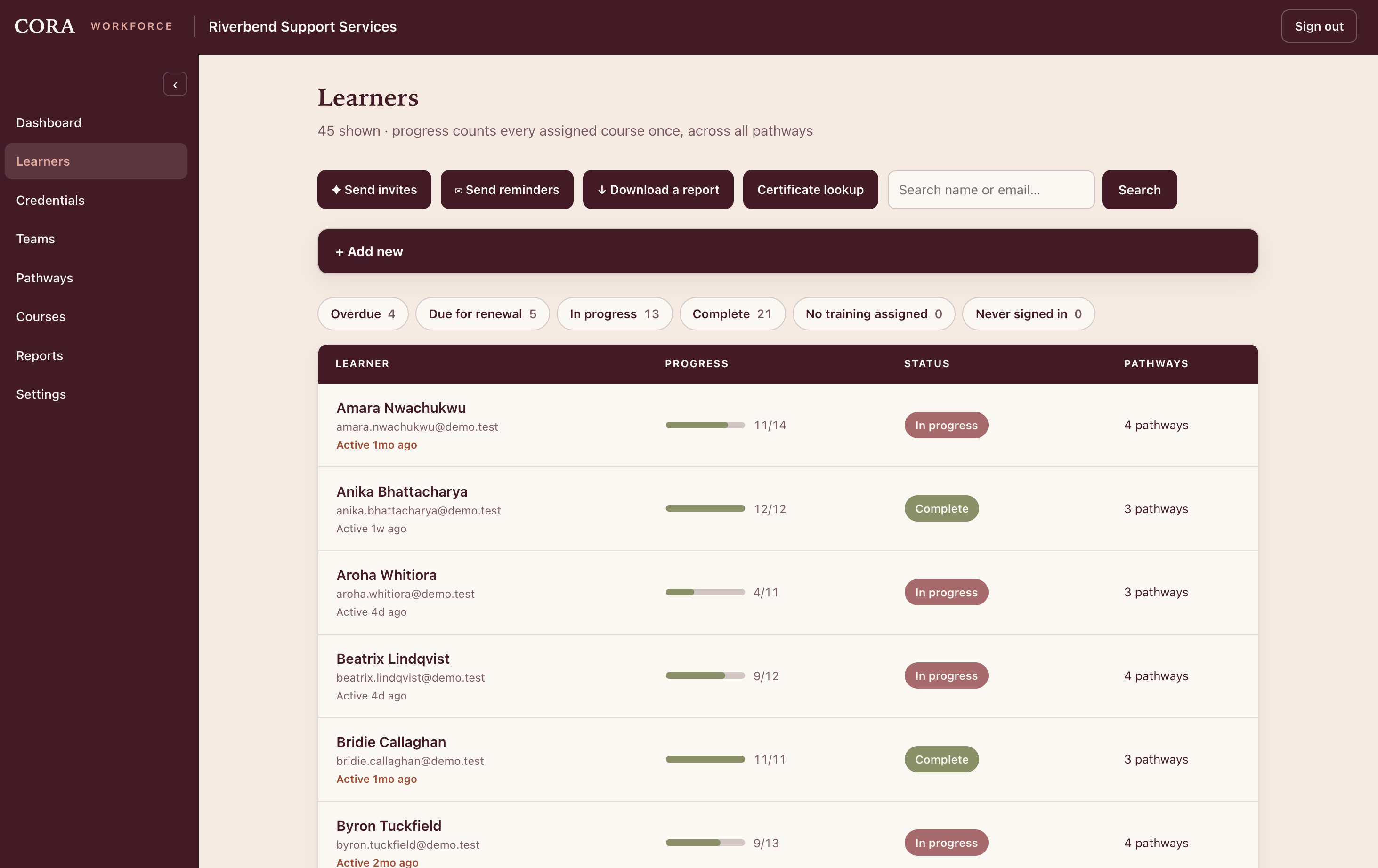
You run everything from portal.coraworkforce.com.au. Sign in with your email and it routes you by role. Add workers one at a time, paste or upload the whole list, or connect your ShiftCare account and CORA reads the staff you already entered there. Either way they appear in one list with progress, status and assigned pathways.
Step 02
Open any worker
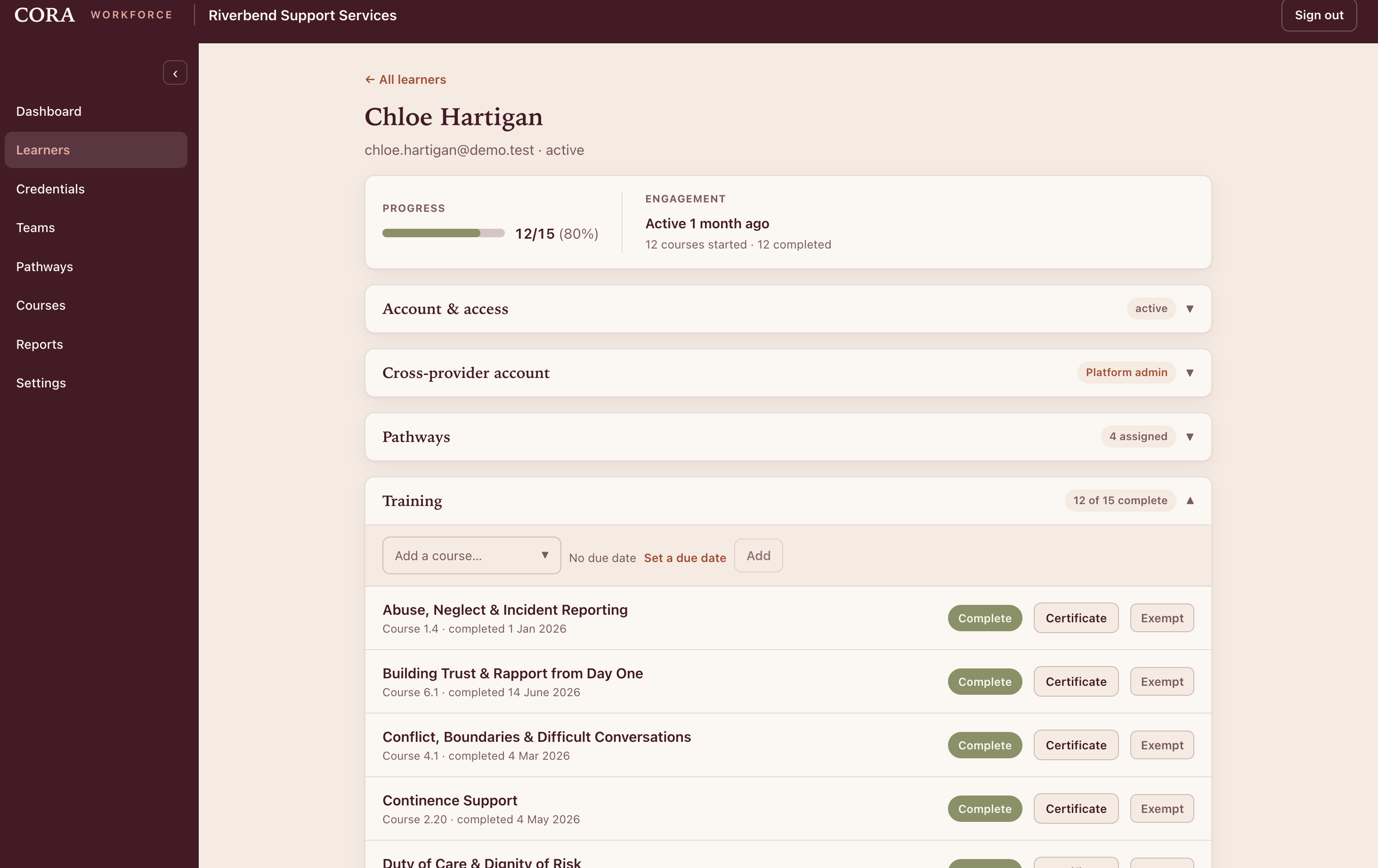
Each worker has a single record. Progress, pathways and training in one place, rather than assembled from three systems when someone asks.
Step 03
Build the pathway, then assign it once
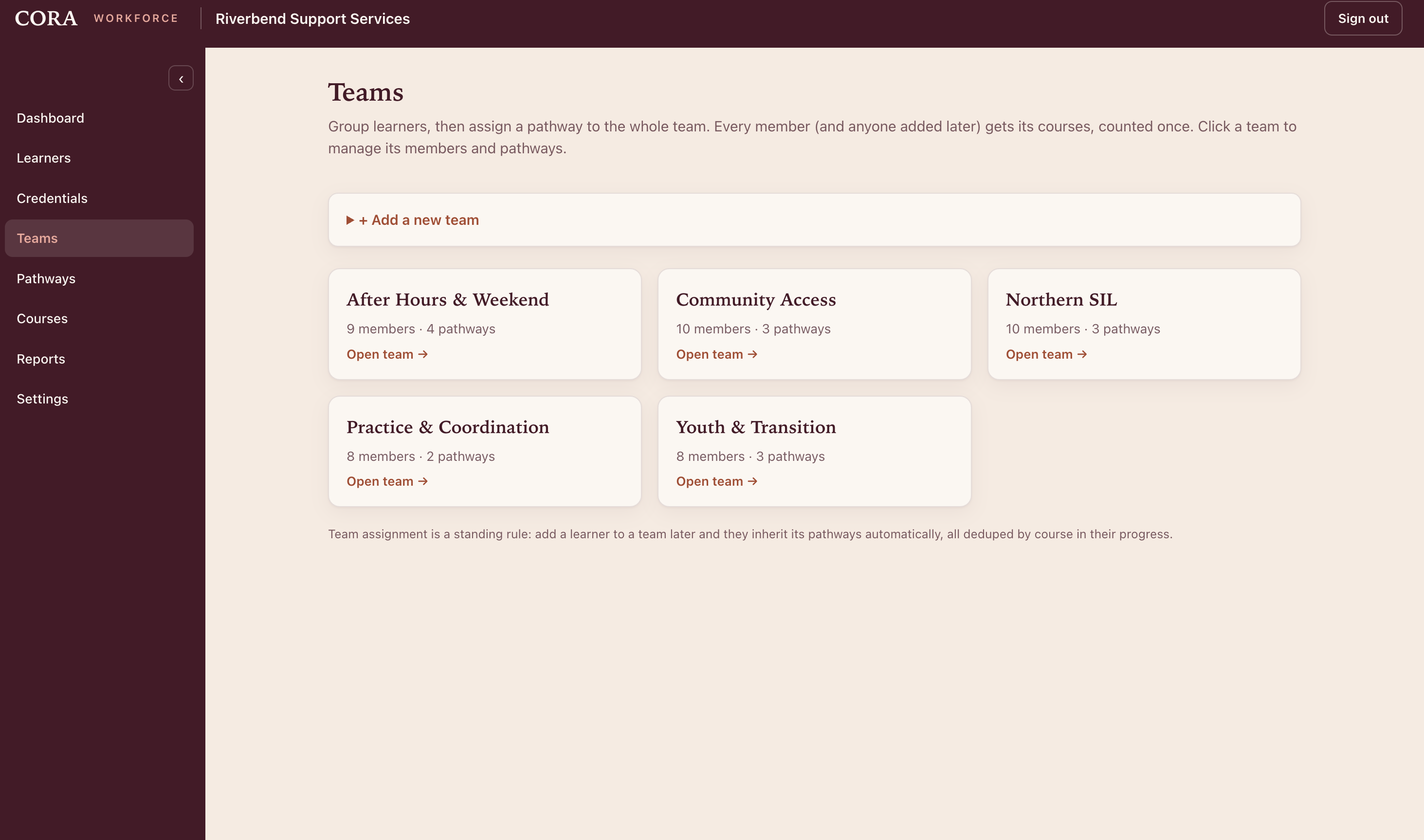
A pathway is a set of courses with per-course due dates, assigned to a whole team in one go, and new members inherit it automatically. You can build one around a role or a site, which is quick and is what most platforms do.
Or build it around the people that team supports. Tell CORA about them in whichever way suits, and none of them start with a blank page: answer a prompted questionnaire covering presentations, how people communicate, the health and behaviour support needs present and the setting, upload a support plan or behaviour support plan you already hold, or simply describe the person out loud, and CORA returns three blocks: the mandatory foundation every worker holds, a tailored layer that exists only because of that profile with a reason written against each course, and a leader layer for team leaders. Nothing is assigned automatically, so you add, remove and reorder before anything reaches a worker.
A role-based list is faster to produce precisely because it is generic. Answering a profile takes a few minutes instead of one click, and what those minutes buy is a pathway that can tell you what each course is for. The builder is free to use with no sign-up.
Step 04
Workers train on their phone
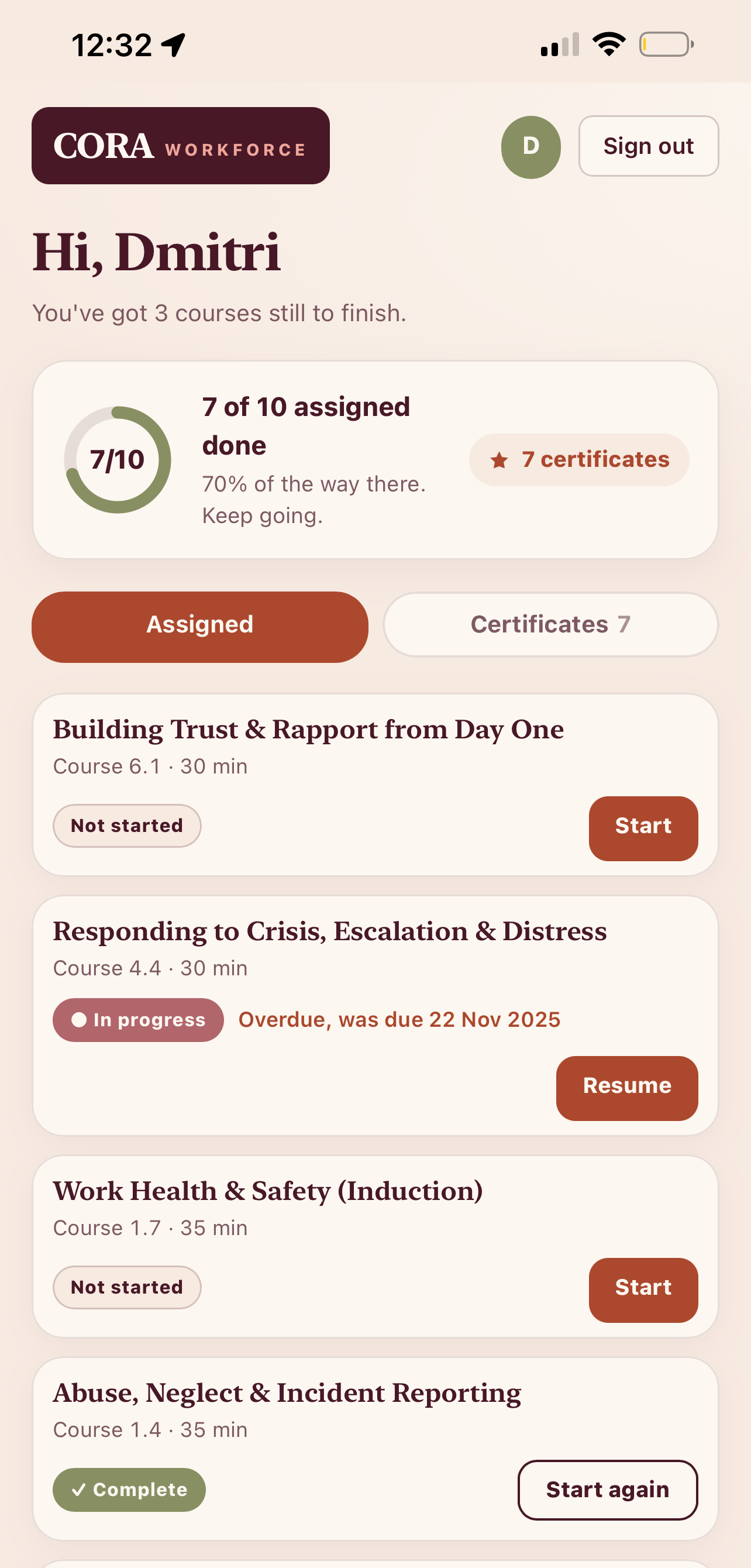
They get a link, sign in, and see exactly what is assigned, in progress and done. No app store, no download, no IT setup.
Step 05
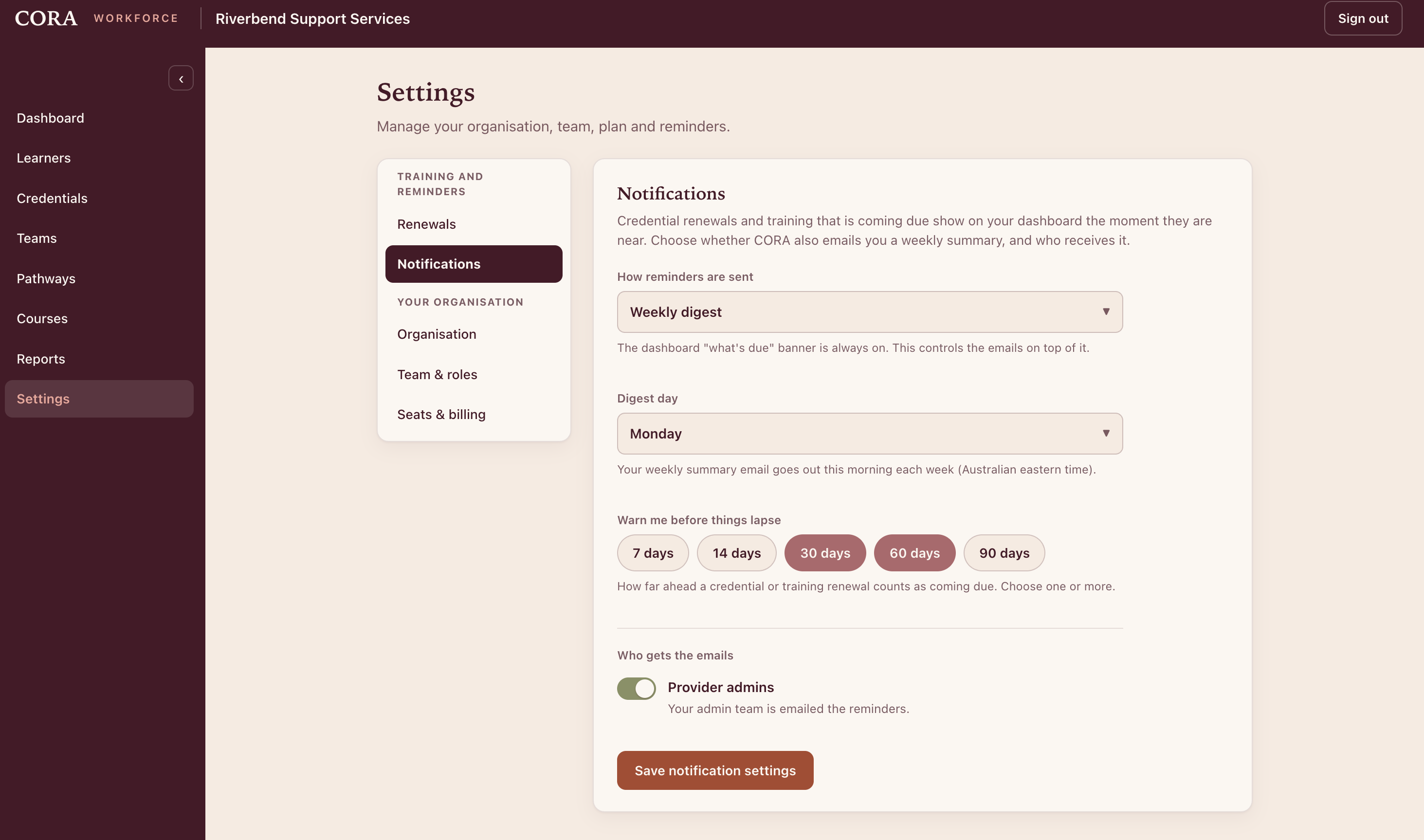
Reminders do the chasing
Set how reminders go out, how far ahead a renewal counts as due, and who gets the weekly summary. Due, overdue and renewal notices keep completion moving, so chasing people stops being your job.
Step 06
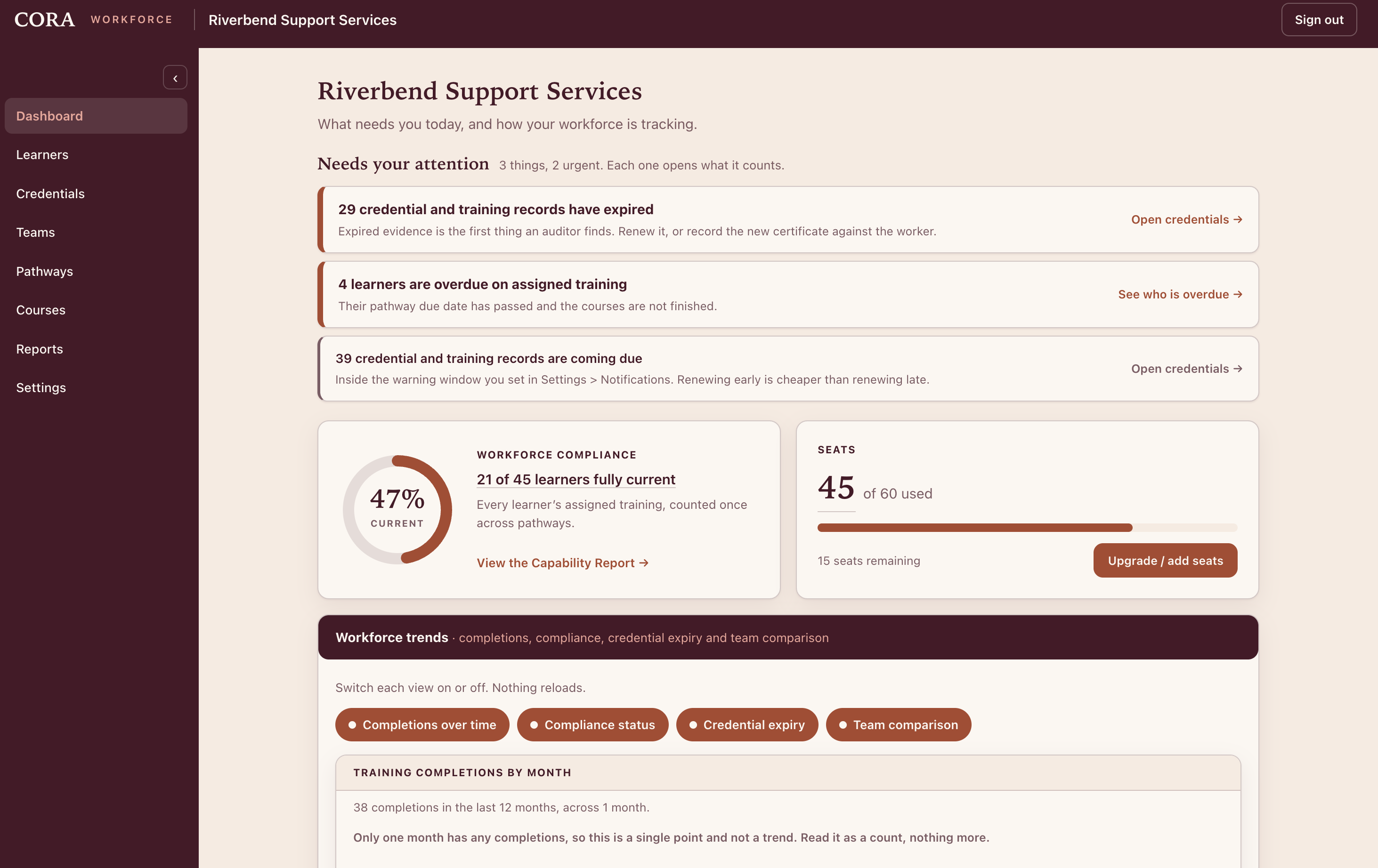
See what needs you today
The dashboard opens on what needs attention, alongside workforce compliance and seats used.
Step 07
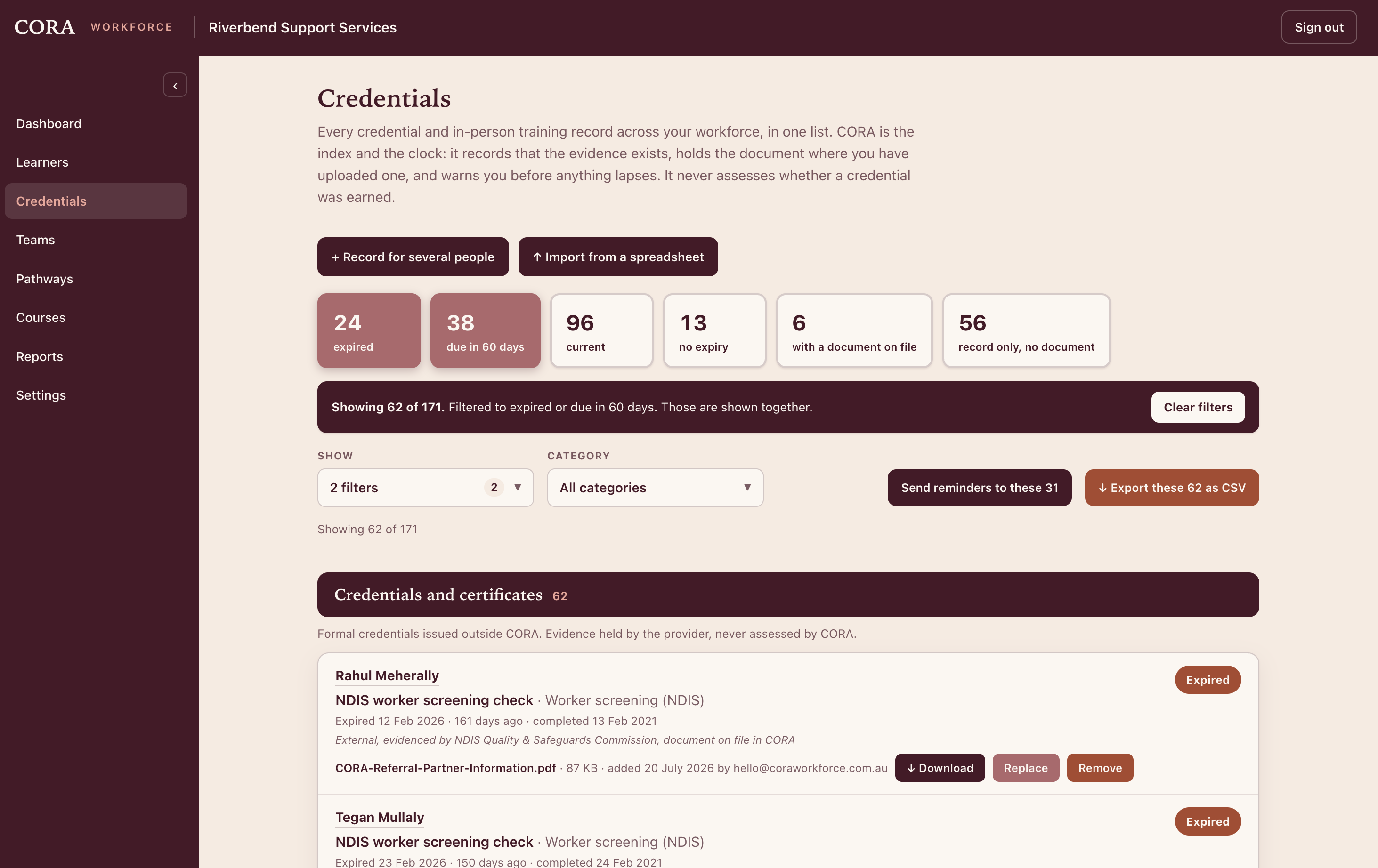
Credentials sit in the same place
Worker screening, first aid, tickets and in-person training, each with a warning before it lapses. CORA records the evidence, it does not assess it.
Step 08
Export what an auditor asks for
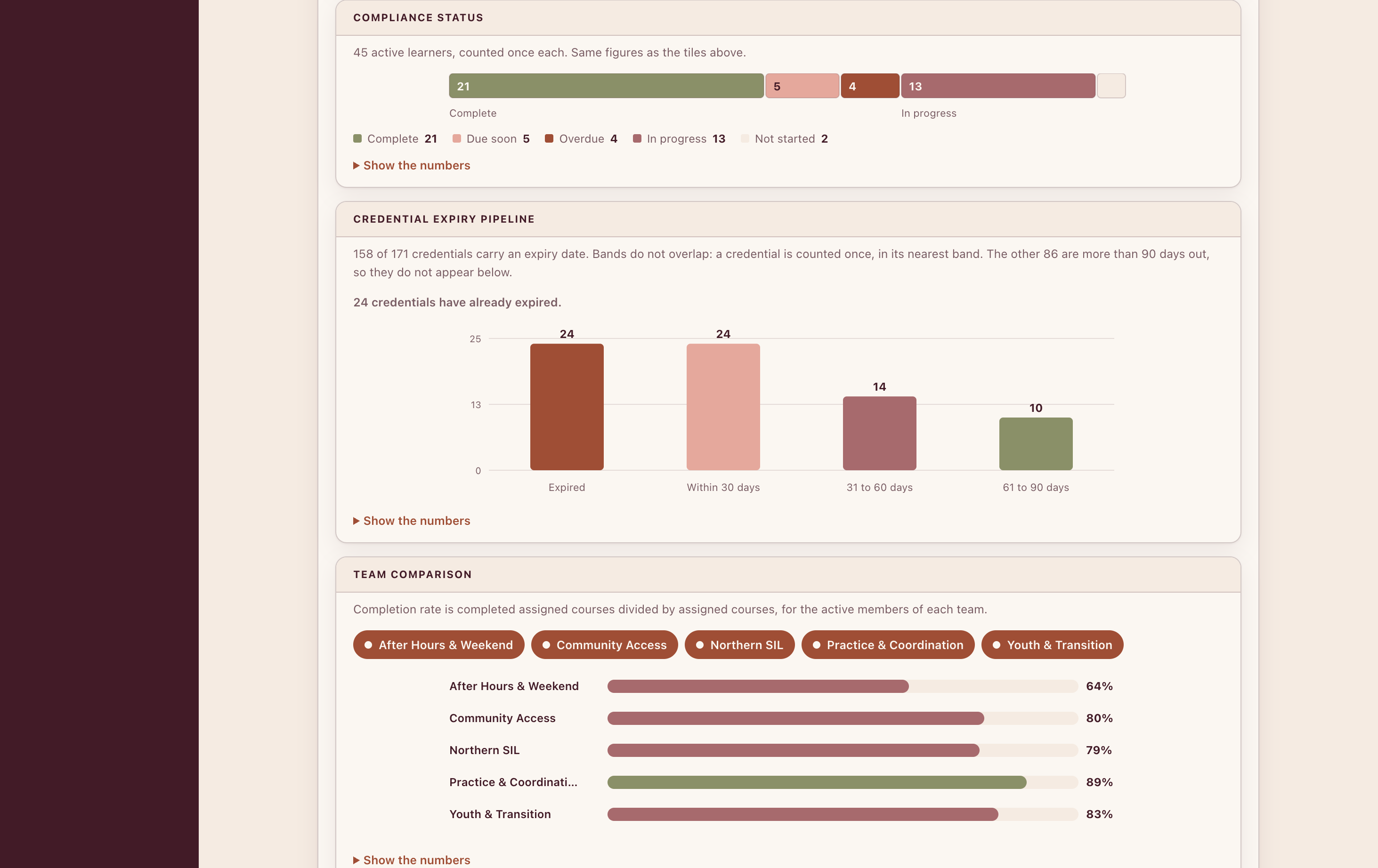
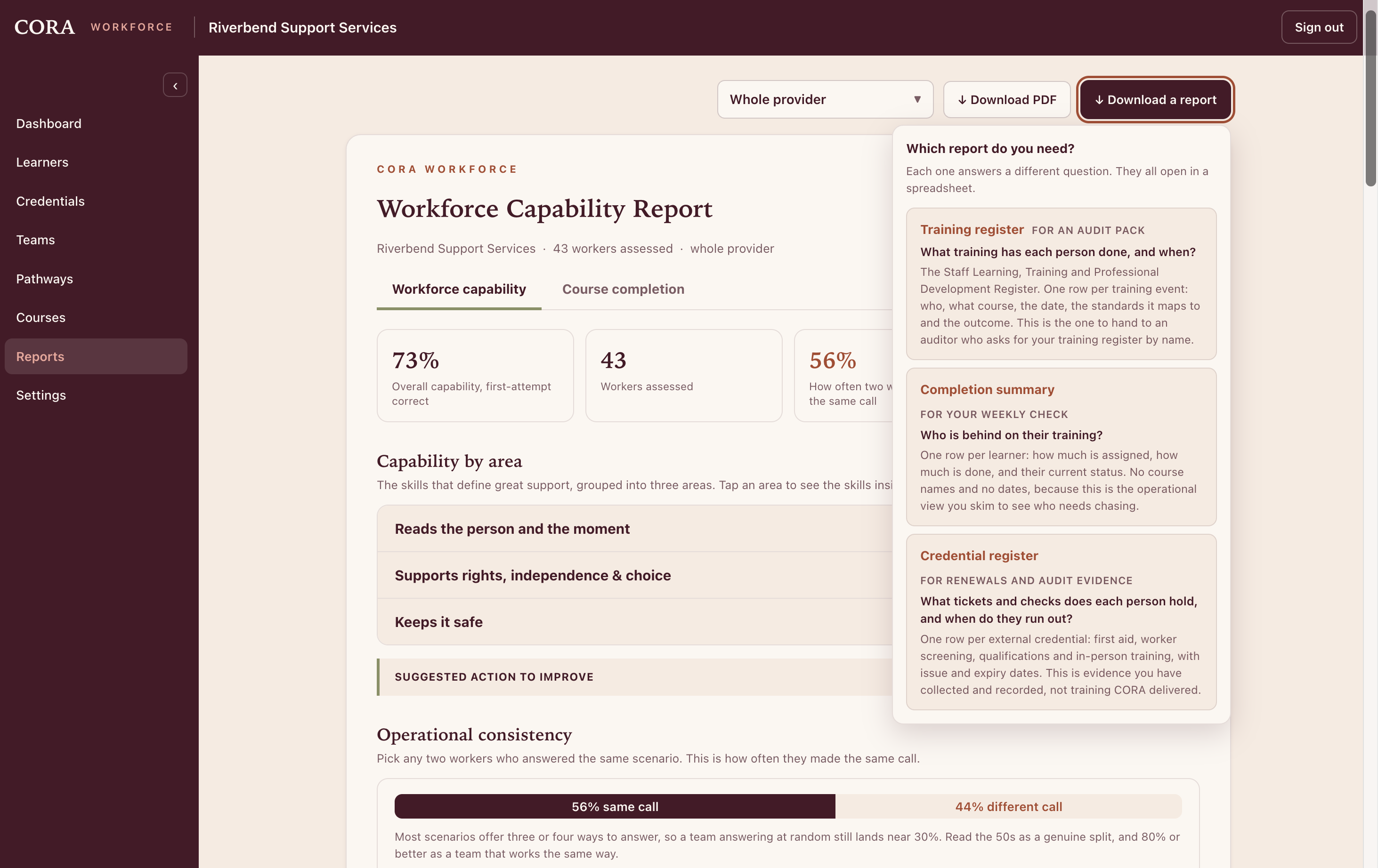
A training register by name, a completion summary and the credential register, ready to export. Alongside workforce trends: completions, compliance, credential expiry and team comparison.
The trigger register exports beside them, and it answers a question a completion record never does: what prompted the training in the first place. Feedback, a complaint, an incident or an identified risk, the workers it concerned, and whether training followed.
None of that is what makes CORA different. It's the minimum a platform running your mandatory training should do. The difference sits above it, in the Workforce Capability Report.
The problem
Proving the training happened is the floor. Most platforms stop there.
Courses get assigned. Workers complete them. Reminders go out. Certificates print. Audits pass. All of that has to happen, and CORA does all of it. The gap is that the workforce isn't measurably more capable on the other side.
This isn't a complaint about workers or providers. It's a description of what most training products are built to do. They demonstrate that training happened, which is genuinely required, and then they stop. Nothing in the record tells you whether practice will hold up on shift.
CORA exists to do both. Frontline workers get training that actually equips them, providers get the compliance records an auditor asks for, and then a layer of workforce reporting that tells them something real.
The CORA model
Direct applied learning.
Every course in the CORA library is built against one test: does this help a frontline worker do their job better on their next shift? If a piece of content doesn't pass that test, it doesn't make it into the course.
That principle shapes everything downstream.
No theory for the sake of theory. No academic or clinical language. Real scenarios in real support settings, with named people facing genuine challenges. Feedback that teaches reasoning, not just confirms answers. Sector-neutral content language, so a worker from any care sector can complete any course and find it written for them.
And nothing to just sit through. Watching someone explain a decision is not the same as making one, so CORA's own courses ask the worker to decide instead. That is a deliberate choice about how adults learn judgement, not a shortcut. When you build your own course you can upload video, audio or a document, and CORA builds the course around it.
A concrete example of what this looks like in practice:
Support workers don't need DSM-style diagnostic criteria for the disabilities of the people they support. They need to know what the person in front of them might be experiencing, how to help them, and how to do it well.
The difference matters. A worker who can recite the diagnostic criteria for autism but doesn't know how to follow the person's lead during a sensory overload isn't more capable, they are more credentialed. CORA builds for the first, not the second.
The result is training that workers can apply on Monday morning, not training they have to mentally translate into their actual job.
A worker can be more credentialed without being more capable. CORA builds for capable.
The four pillars
Four things a capable workforce actually needs.
Every CORA course is structured around four pillars. Three are built in workers. The fourth is what providers see at the organisational level.
Capability
What a worker sees and understands. The recognition, framing, and judgement that has to be in place before practice can be good. Knowing what something is, recognising it when you encounter it, understanding why it matters.
Operational Consistency
What a worker does the same way, every time. Consistent practice across every shift, every person, every situation it's designed for. Every worker doing the right thing the same way, regardless of experience, mood, or who's watching.
Readiness
What a worker does when the situation doesn't fit the standard pattern. The capacity to handle variation, edge cases, and hard moments. Knowing the limits of the role, when to escalate, and how to sustain through difficult shifts.
Assurance
What the provider can be confident about overall. The workforce-level summary of completed training, governance coverage, and audit preparation. The number a provider can take to their board or to an audit.
Why these four
Each pillar points to a different fix.
A workforce can look strong on one pillar and weak on another. The diagnostic resolution is what makes the Workforce Capability Report actually useful, rather than something a Quality Manager files away.
low Op Consistency
The team understands the work but doesn't reliably execute it.
The fix is practice discipline, not more theory. Workers can describe what good support looks like, but the same situation gets handled three different ways across three different shifts. The training already covered the concept; what's missing is the repeatable habit.
low Readiness
The team handles standard shifts well but freezes when something unfamiliar happens.
The fix is exposure to variation and explicit guidance for harder situations. Workers handle the 80% of shifts that follow the pattern, but get stuck on the 20% that don't. They need to see what the same skill looks like applied to different people, and what to do when it gets hard.
low Assurance
The capability is there, but coverage isn't.
The fix is completion, not retraining. The workers who have done the training know the work. The problem is that half the workforce hasn't been assigned it yet, or hasn't finished. This is the gap that audits surface and the Workforce Capability Report flags before audit catches it.
This is the diagnostic resolution that turns "your workforce needs more training" into "your workforce needs this specific kind of training, for this team, before this audit."
See a sample report →How the model lands in a course
Three lessons. Each one builds a different pillar.
The four-pillar model isn't an abstract layer on top of training. It's the structure of every course in the library.
Understanding the Topic builds Capability.
Recognition, framing, the why. The awareness layer the worker needs before applying any skill. Includes one rich worked example and one brief contrasting example so the worker can recognise the topic in different shapes. Also surfaces the individual variation principle, that a label or diagnosis doesn't tell you how this person experiences the world.
How to Apply It builds Operational Consistency.
Skills broken into actionable steps, with worked examples of what good practice looks like in action. Two branching scenarios in real support settings put the worker in standard situations and test applied judgement. Every option carries substantive teaching feedback, including the correct one. Workers see all three feedbacks before advancing, because the teaching value sits as much in understanding why the wrong-but-plausible options were tempting as in finding the right answer.
Doing It Well and Doing It Every Time builds Readiness.
Variation across people and situations. What to do when it gets hard. An integration scenario that requires multiple skills applied at once under pressure. A four-question knowledge check that tests recognition, applied practice, and handling variation. The course closes with a completion certificate for your training register, and a capability statement that names what the worker has built.
What providers get
The Workforce Capability Report is where the model pays off.
Every compliance platform can tell you a course was finished. The Workforce Capability Report tells you whether it landed. Included for every provider, it's an on-demand executive narrative that scores the workforce against the four pillars, identifies specific risks and gaps, and recommends actions tied to upcoming audit timing.
The report is the layer that converts the in-course capability assessments, the decisions workers make inside every course, into something a provider can actually use. It sits on top of the dashboard and the certificates, not instead of them: a narrative that names what's strong, what's weak, and what to do about it before the next audit cycle.
CORA supplies the structure, the records and the worker-by-worker visibility. Signing off on-the-job competency, where observed assessment applies, stays your qualified assessor's call.
Want to see if CORA fits your workforce?
Let's talk it through.
If you'd like to walk through how CORA would work for your team, get in touch.
Not sure which records you're missing yet? Try the free training records self-check.